
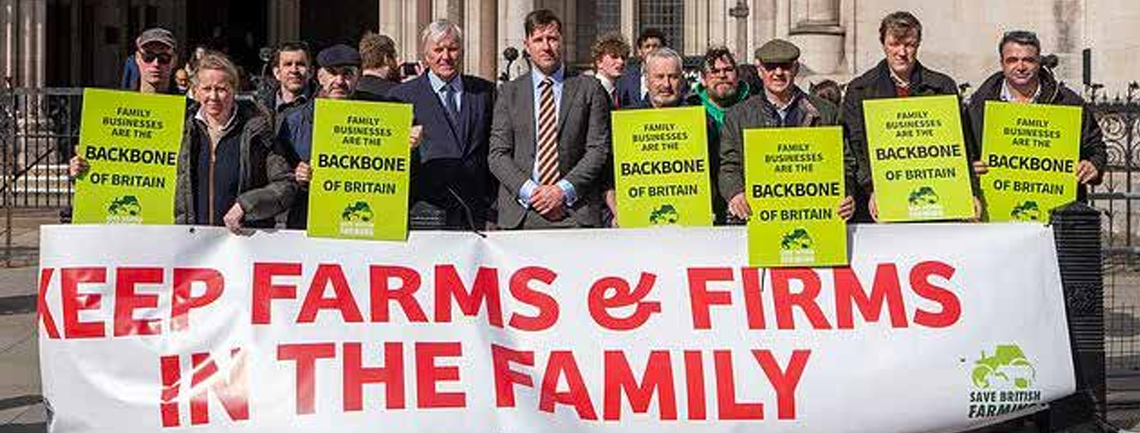
If you’ve driven on a dual carriageway in Kent, Su olk, Northamptonshire, or pretty much anywhere with farmland in the last year and found yourself stuck behind a slow-moving convoy of tractors with signs reading “No Farmers, No Food,” you’ve witnessed one of the more striking political reactions to a Budget measure in recent memory. Thousands of farmers have driven their tractors through London. Hundreds more have staged go-slow protests on the A14, the A5, and through towns from Darlington to Dover. The National Farmers’ Union has called it “an attack on the countryside” and accused the government of “betrayal.” So what, exactly, did the Budget actually do?
The Mechanics: From “100% Forever” to “100% Up to a Point”
Since 1984, Agricultural Property Relief (APR) has allowed qualifying farmland to pass to the next generation entirely free of inheritance tax, and Business Property Relief (BPR) has done something similar for qualifying business assets, including farm machinery, buildings, and livestock. Combined, these reliefs meant a working farm could, in principle, pass from one generation to the next without triggering a 40% inheritance tax bill on land that might be worth millions on paper but generates a modest income.
From 6 April 2026, that changes. The full 100% relief is now restricted to the first £1 million of combined agricultural and business property. Above that threshold, relief drops to 50%, meaning inheritance tax is charged at an e ective rate of 20% rather than the standard 40%, with ten years to pay the bill, interest-free. Following the Budget 2025, the government also made the £1 million allowance transferable between spouses, in response to the backlash, which the O ce for Budget Responsibility and various briefings now describe as giving married couples a combined allowance closer to £2.5 million once everything is taken into account. The NFU’s president called this softening “a huge relief for many,” while also saying it “did not go far enough.”
The Numbers Nobody Can Agree On
Here’s where the debate gets genuinely heated, because the government and the farming industry are working from wildly di erent estimates of how many people this actually a ects, and the gap between them is enormous. The government’s original position was that around 2,000 estates a year would be a ected, later revised down in some statements to roughly 500 estates a year, framed as “a fair and balanced approach” a ecting a small minority of the wealthiest landowners. The NFU and the Country Land and Business Association, by contrast, have put the figure at around 70,000 farms over the coming decade, and cited the government’s own Department for Environment, Food and Rural Aairs data as suggesting that 66% of farms could face higher bills under the new rules, with some independent tax experts agreeing that 70,000 is closer to the mark than 500.
Why such a huge gap? A large part of it comes down to how the £1 million threshold is calculated. It’s not just land. It’s land, buildings, machinery, and livestock combined, the entire operational asset base of a working farm. A single modern tractor can cost in the region of £200,000. Add a few of those, a grain store, a slurry tank, a flock or herd, and the farmhouse itself, and a farm that produces a genuinely modest income can easily find its combined agricultural and business property crossing £1 million well before you’ve counted a single acre of the actual land. One tax adviser working with Norfolk farmers put it starkly: with agricultural land returning somewhere between 0.5% and 1% a year in income terms, a 20% charge on the capital value, even spread over ten years, is “una ordable” for many, and “it’ll happen a lot” that farmers end up having to sell land simply to pay the tax on land they’re trying to keep.
The Fairness Argument Deserves a Hearing Too
In the interests of giving this debate its due, the government’s underlying argument isn’t baseless. Its own figures show that 47% of the total cost of APR and BPR relief, around £219 million a year in total, has gone to just the top 7% of claims. That’s a genuinely striking concentration, and it reflects something that’s been an open secret in farming and tax planning circles for years: agricultural land has become an increasingly popular vehicle for very wealthy individuals specifically because of the inheritance tax exemption, pushing up land prices for people who actually want to farm, while the relief itself was being claimed disproportionately by a small number of very large estates. Jeremy Clarkson himself has been admirably candid on television about buying his Diddly Squat farm partly for exactly this reason. If the policy goal is “stop large investment portfolios from sheltering behind a relief designed for working farmers,” that’s a defensible goal, and the concentration data suggests there was a real problem to solve.
Where the Policy Falls Down
The trouble is that the instrument chosen to fix that problem is blunt in exactly the way that catches the people it wasn’t aimed at. By combining APR and BPR into a single £1 million cap that includes machinery, livestock, and buildings alongside land, the policy doesn’t really distinguish between “a pension fund that bought 2,000 acres as an inheritance tax shelter and rents it out to a tenant farmer” and “a fifth-generation family that’s farmed the same 400 acres since 1883, owns the tractors it needs to work that land, and makes £45,300 a year doing it,” which is roughly the government’s own figure for average farm profits. Both can end up with a combined agricultural and business property value well over £1 million. Only one of them looks anything like the “wealthy investor” the policy was nominally targeting.
This is, structurally, a very similar problem to several others we’ve covered in this series: a threshold that sounds reasonable in isolation (£1 million! Surely that’s generous!) but interacts badly with how asset values actually work in the real world, in this case the simple fact that modern farming requires expensive machinery and substantial acreage to be viable at all, meaning “asset rich, cash poor” isn’t a description of unusually wealthy farmers, it’s a description of nearly all of them.
What Happens Next
The painful irony in all of this is what the “solution” often looks like in practice. A farming family facing a six-figure inheritance tax bill on assets generating a 0.5% to 1% income yield, with ten years to pay, often has only one realistic option: sell part of the farm. And who’s most likely to be in a position to buy a parcel of agricultural land at short notice? Often, the very same category of investor, pension funds, wealth managers, large landowners, that the policy was supposedly designed to discourage from holding farmland in the first place, or alternatively, housing developers, which is its own separate and longstanding source of friction in rural communities. There’s a genuine risk that a policy aimed at reducing the concentration of farmland in the hands of large investors ends up accelerating exactly that, by forcing smaller family operations to sell to exactly those buyers in order to pay the tax bill that the larger operations, with better cash flow and professional advisers, are often better equipped to absorb or plan around.
For farming families reading this, the practical takeaway echoes something from our earlier piece on inheritance tax generally: the ten-year interest-free payment window is genuinely useful, and the earlier you start planning around it, lifetime gifting, life insurance policies written into trust to cover a future liability, and yes, holding a portion of the family’s wealth in liquid, income-producing assets like gilts specifically earmarked to cover a future IHT bill rather than everything being tied up in land and machinery, the less likely you are to be the family standing in a field in ten years’ time, doing the maths on which forty acres has to go.
There’s a broader lesson here for anyone who isn’t a farmer too. Land and machinery are about as illiquid as assets get, you can’t sell a single hedge or half a combine harvester to cover a tax bill, you have to sell whole fields or whole machines, often at short notice and not necessarily at the best price. The same logic applies, in miniature, to anyone whose wealth is overwhelmingly tied up in property, a business, or other illiquid assets, with little in the way of cash, gilts, or other readily realisable holdings sitting alongside it. A tax bill doesn’t care how illiquid your assets are. Having even a modest slice of your wealth in something you can actually sell on a Tuesday afternoon, without putting half the farm on the market, isn’t glamorous, but as this entire series has been arguing, glamour was never really the point.
This article is a personal opinion piece for general information and does not constitute financial, tax, or legal advice. Agricultural Property Relief and Business Property Relief rules are complex and depend on individual circumstances. If you’re a farmer or landowner concerned about how these changes affect you, speak to a qualified accountant or solicitor specialising in agricultural estates.